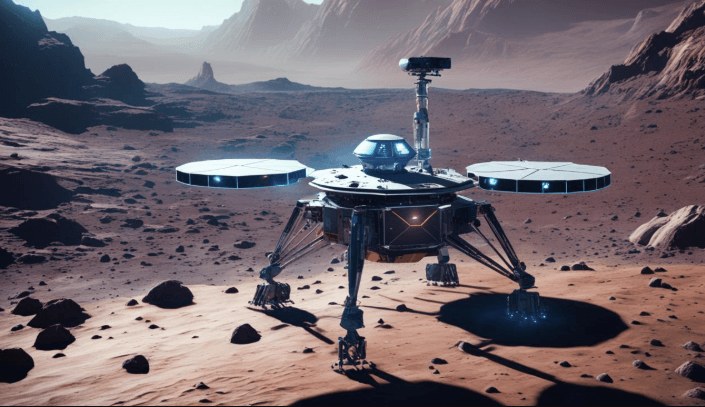
AI in space missions offers rapid, in-situ decision-making, robust fault detection, and adaptive planning within edge computing and modular architectures. An AI sensing and planning framework translates sensor streams into structured, policy-aware actions, merging context for governance. Safeguarding through anomaly detection and cross-layer diagnostics supports containment and recovery. Real-world use cases—from orbital autonomy to planetary rovers—pose governance and ethics questions that must be addressed to enable reliable, auditable deployments. The implications merit further, careful consideration.
What AI Brings to Space Mission Autonomy
AI enhances space mission autonomy by enabling rapid, in-situ decision-making, robust fault detection, and adaptive planning without real-time ground intervention. Systems analyze edge computing data streams to sustain operations, isolate anomalies, and reconfigure workflows. Biosignature interpretation informs context-aware responses, while modular architectures support scalable resilience. The approach emphasizes rigorous assessment, disciplined interfaces, and mission-focused autonomy for controlled, freedom-driven exploration.
From Data Streams to Decisions: AI Sensing and Planning
From the framework of autonomous analysis established in the prior discussion, data streams collected at the edge are mapped into structured sensing and decision-analytic processes. AI sensing integrates sensor fusion, contextual interpretation, and policy-aware planning, enabling adaptive mission execution.
ai ethics and fusing autonomy guide governance, ensuring transparent criteria, auditable decisions, and disciplined autonomy integration within complex, constrained space environments.
Safeguarding Missions: AI Fault Detection and Resilience
Safeguarding missions hinges on timely fault detection and robust resilience mechanisms that operate under strict resource and environmental constraints.
The analysis emphasizes fault tolerance architectures, anomaly detection methods, and structured resilience planning.
Fault isolation enables containment without mission disruption, while cross-layer diagnostics provide actionable insights.
Systematic evaluation under realistic fault models informs design choices and supports autonomous decision-making for mission-critical continuity.
Real-World Use Cases and Future Trajectories in Space AI
The deployment of intelligent systems in space missions is already yielding concrete operational benefits, with real-world applications spanning autonomy in orbital operations, planetary rovers, and deep-space probes.
Realized gains prompt rigorous evaluation of AI ethics, space governance, and autonomous system testing, advancing planetary protection and data compression.
On board AI hardware, cross domain collaboration, and human–AI teaming shape future trajectories with clarity.
Frequently Asked Questions
How Do AI Systems Get Initial Training Data for Space Missions?
Initial training data for space missions arises from simulated environments, historical mission logs, and synthetic sensor streams; analysts emphasize rigorous training data collection and anomaly detection to build robust, mission-focused AI capable of generalizing under uncertain conditions.
What Governance Processes Ensure AI Decisions Are Auditable in Space?
Governance processes ensure AI decisions are auditable in space through formal compliance auditing and robust governance frameworks, enabling traceability, repeatability, and accountability; they structure risk management, data provenance, and decision logs to support mission-focused, systems-thinking scrutiny.
How Will AI Handle Novel, Unseen Celestial Environments?
AI will adapt via robust uncertainty modeling, exploratory testing, and modular fallback strategies to handle novel, unseen celestial environments. It prioritizes mission objectives while maintaining safety, balancing unrelated topic and off topic discussion within disciplined, rigorous analysis.
See also: AI in Space Exploration Missions
What Are the Ethical Implications of Autonomous Space Decision-Making?
Like a compass in windless space, the analysis notes: ethics of autonomy, decision accountability, governance and auditing, novelty handling. It concludes that autonomous decision-making requires rigorous governance, transparent auditing, and clearly assigned accountability to safeguard mission objectives and safety.
How Do AI Systems Manage Hardware Resource Constraints in Space?
AI systems manage hardware resource constraints by prioritizing tasks, reallocating power, and adjusting throughput; optimizing power and managing thermal are central, leveraging predictive models, fault-tolerant scheduling, and adaptive redundancy to sustain mission-critical operations under varying loads.
Conclusion
AI-driven space systems embody a disciplined fusion of perception, planning, and resilience. By translating streams of sensor data into structured decisions, these architectures enable autonomous risk-aware operations, adaptive mission pacing, and graceful degradation under uncertainty. While governance and ethics establish guardrails, robust fault detection and cross-layer diagnostics ensure continued progress with minimal disruption. In sum, space AI offers a carefully calibrated escalation of capability—softly advancing mission objectives while preserving safety, reliability, and long-term scientific return.
